
How to Choose a Fire Retardant Tent for Outdoor Events

Planning an international outdoor event comes with a long list of logistics, but nothing is more critical than safety compliance. If you are an event organizer, festival planner, or rental company, one question stands above all others during a site inspection: Are event tents fire-retardant?
Choosing the right temporary structure requires navigating a maze of regional laws, fabric types, and safety certifications. In this guide, we will break down how to choose a fire retardant tent for outdoor events, decode international grading systems, and explain how to protect your investment and your guests.
Table of contents
Fire Retardant vs. Fireproof: The Technical Difference
When searching for safe event dome tents, you will frequently see terms like fireproof tent or fire proof tent used interchangeably with fire retardant tent . However, from a technical and legal standpoint, there is a massive difference.
- Fireproof tent: In reality, a truly “fireproof” fabric does not exist for commercial event tents. If a fabric is exposed to a continuous, extreme direct flame, it will eventually degrade or melt.
- Fire retardant tent: A flame retardant tent is engineered to resist ignition, slow down flame spread, and self-extinguish once the heat source is removed.
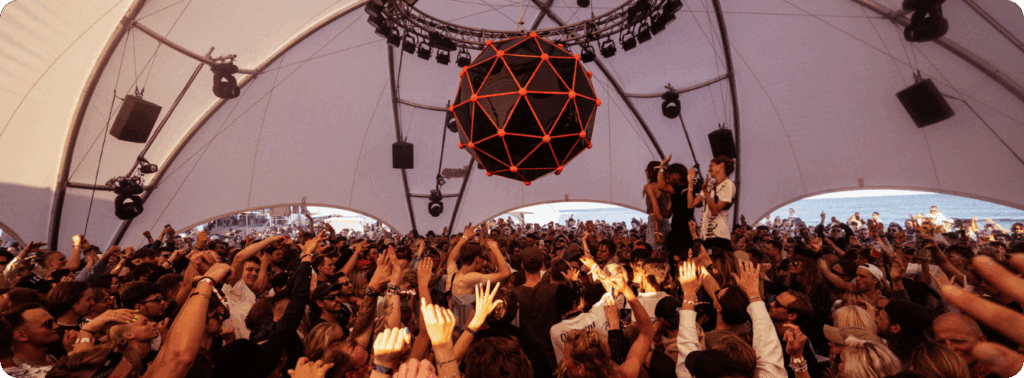
According to material testing criteria established by the Deutsches Institut für Normung (DIN), ‘B1’ or ‘difficult to ignite’ (schwerentflammbar) is the highest achievable class for organic materials like tent fabrics before they would have to be classified as non-combustible steel or concrete. For the event sector, you do not need a mythical “fireproof” structure; you need a high-quality fire retardant tent or a certified fire retardant canopy that gives crowds valuable time to evacuate safely and prevents a small accident from turning into a major catastrophe.
How Do You Know If a Tent is Fire Retardant? Global Standards
If a local fire marshal walks onto your event site, they will immediately ask: What are the key safety standards for fire retardant tents? To prove compliance, you cannot just say the fabric is safe, you must present an official tent flame retardant certificate or specific regional test ratings.
The test methods behind certifications such as the EN 13501-1 are based on rigorous International Organization for Standardization (ISO) standards (such as ISO 6941), which precisely measure the exact number of seconds a fabric takes to self-extinguish.
At Creative Structures, our global structures are engineered and certified to meet the strictest fire safety demands across Europe, North America, and beyond. Here is how international fire safety ratings translate by region:
| Country / Region | Official Safety Rating | What the Buyer Needs to Know |
|---|---|---|
| Germany | B1 / DIN 4102-1 | Central Europe’s gold standard. Ensures the material is highly flame-resistant and self-extinguishing. |
| France | M2 / NFP 92-507 | France utilizes the strict “M” scale. An M2 rating proves the material is strictly fire-retardant. |
| United Kingdom | BS 7837 | Specifies performance requirements for textiles and PVC fabrics used in marquees. |
| United States | Method 2 / NFPA 701 | To pass a rigorous safety inspection in the US, an NFPA 701 certified tent is the mandatory safety standard enforced by fire marshals for public outdoor gatherings. |
| California (USA) | CSFM T19 | California State Fire Marshal Title 19 standard, often required across the US for stringent flame resistance. |
| USA Building | Class A / ASTM E84 | Measures flame spread and smoke density inside structures. |
| Canada | CAN ULCS109 | The Canadian national standard for flame tests on fabric and films. |
| Global Camping | CPAI 84 | A widely recognized CPAI 84 fire retardant certificate ensures the textile meets the canvas standard for flame-resistant materials. |
| Italy | Classe 2 / UNI 9177-87 | The Italian standard for classifying the reaction of materials to fire. |
| Spain | M2 / UNE 23727-90 | The official Spanish fire-retardant classification. |
| Switzerland | VKF 5.3 / SN 198898 | Swiss canton-level compliance for temporary outdoor event structures. |
| Australia & NZ | 1530.2 & 3 / AS/NZS | Covers the indices for flame propagation, heat release, and smoke release. |
| Eastern Europe | G1 / GOST 30244-94 | The official regulatory standard for low-flammability materials. |
When buying structures, always look for fire retardant tents for sale (40 monthly searches) that explicitly list these exact certificates.
Materials Matter: Inherent Protection vs. Chemical Coatings
When researching what materials are used in fireproof outdoor tents, you need to look closely at how the flame retardancy is achieved. This heavily impacts your long-term return on investment (ROI).
- Flame retardant treated (FRT): Some cheaper event canopies are made of basic fabrics sprayed with a chemical fire-retardant film after production. Material science studies regarding polymer aging show that topical chemical treatments degrade significantly when exposed to UV radiation and rain (hydrolysis) within 12 to 24 months. You run the risk of failing an inspection a year after purchase unless you constantly re-treat the fabric.
- Inherent flame retardant (IFR): High-end professional structures, like those from Creative Structures, use high-performance materials (such as premium coated PVC and specialized PU fabrics) where the fire-retardant properties are built directly into the molecular structure of the material. It cannot wash out, wear off, or degrade over time, ensuring your investment retains its molecular fire resistance for decades.
Built for Live Cooking: Integrated Grilling Hoods
In the modern event sector, hospitality and live catering are massive revenue drivers. However, cooking under a standard event canopy is a major fire hazard due to rising heat, grease particles, and open flames.
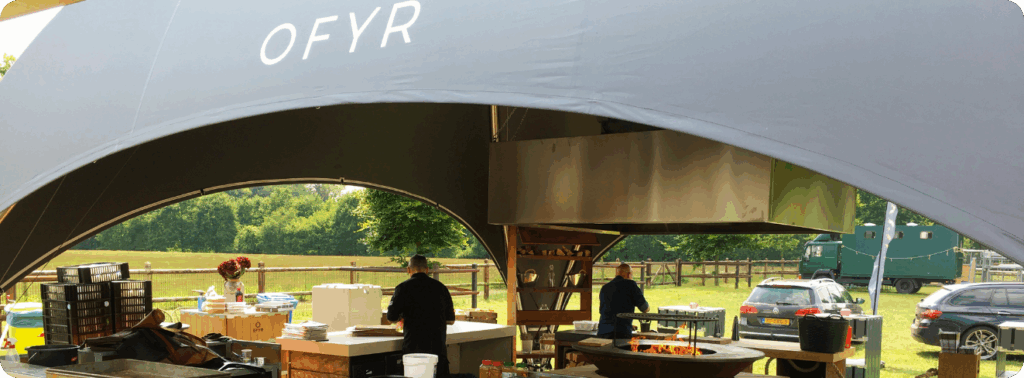
Because Creative Structures fabrics are rigorously tested to meet the highest global flame-retardant standards, our tents are perfectly safe to cook under.
To elevate live catering safely, we have designed integrated grilling hoods that fit seamlessly into our modular tent systems. These specialized hoods efficiently channel smoke, heat, and grease away from the cooking station, allowing your chefs to put on a spectacular culinary show right under the tent canopy without compromising on safety or compliance.
Long-Term Maintenance and Storage for Fire Retardant Canopies
To maintain the structural integrity and legal compliance of your fire retardant canopy, proper maintenance is key:
- Avoid aggressive solvents: When cleaning your tent fabric, avoid harsh chemical solvents or bleach, which can damage the top-coat finish of the fabric. Use mild, manufacturer-approved soapy water.
- Prevent mold and mildew: Never pack away your tent while it is wet. Even though the fabric resists fire, trapped moisture can breed mold, which weakens the fabric fibers over time.
- Logbook maintenance: Keep a dedicated folder with copies of your official fire certificates paired with your tent purchase invoices. Having this readily available for your crew on-site saves hours during sudden field inspections.
Get in touch for expert advice
When you invest in a Creative Structures tent, you can be sure that they are fire-retardant. Because our structures hold a comprehensive roster of global certificates (including B1, M2, NFPA 701, and CPAI 84), you can confidently hand over your paperwork to any local inspector anywhere in the world, ensuring a smooth, stress-free approval process.
Are you ready to upgrade your event inventory with premium, globally certified structures that combine striking design with absolute safety? Whether you need an nfpa 701 certified tent for the US market or a B1/M2 compliant structure for Europe, Creative Structures has you covered.
Contact our team today for a non-binding, free consultation. We are happy to help you find the perfect fire-retardant solution tailored specifically to your international event needs!